Showing posts with label culture. Show all posts

Thursday, September 8, 2011

World Heritage


My journey to Malaysia started with a plane ride from Bangkok where I was seated next to a cute 15 year old Thai girl. After overhearing her conversation with a lady next to her I found out she was studying in Malaysia and living with her aunt to hopefully have a better chance at learning english. We were about to land and I asked her what was the best way to get to George Town, the center of Penang. Having her Thai generousity she offered me a ride with her aunt since they would be heading that way too. Her Aunt, Isha, is a large Muslim women dressed in a traditional burka who greeted me with a firm hand-shake and perfect english after passing through customs. After talking in the car I learned we shared many mutual thoughts about the importance of traveling, teaching, and the environment. Isha had studied in Egypt and Indonesia for 7 years becoming fluent in 4 languages, Malay, English, Arabic, and Thai. She is an environment and moral teacher at a government elementary school. After I revealed to her that I had no plans or hotel reservations for my stay in Penang she said, "I think you stay with me, yes." She lives with 3 other muslim women in a small traditional section of the city that usually doesn't allow anyone outside the muslim faith stay there. Knowing this would save me a lot of money and provide me with a unique experience of living in Malaysia in a muslim house, I graciously accepted. She says her house is 'heritage' and contains only the basic necessities.
Throughout the 6 days on Penang Island I toured many different temples and mosques, enjoyed a hike through the national park, walked through 'little india', went to prom, observed a local elementary school, and ate traditional food.
Snake Temple: where dozens of vipers live
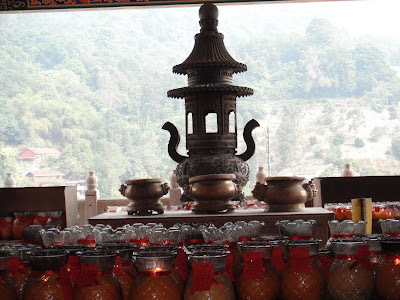
Kek Lok Si temple
Chinese ribbon wishing tree
Kindergarden Room at the school
Mosque
Chinese Temple
How tourist travel...no Tuk Tuks here!
Hindu Temple

Penang is known to embrace modernity, with the chains such as Starbucks, KFC, Mcdonalds and skyscrapers scattered throughout the island, while keeping its 'old world charm' and is listed as a World Cultural Heritage Site. This is mainly because of the unique blend of people that live on the island. There are Indian, Chinese, Indonesian, British, Malay, and Thai and can be seen simply by walking down the street or at the vast array of places of worship on the island. Because Penang used to be a British colony, there is an old fortress still standing on the island, the educational system has implemented a british curriculum. This is why all the people could speak fluent english and why Lulu, the thai girl, was sent to Malaysia to study. Also while walking on the street the architecture of the buildings change from one street to the next. There will be a huge european white building and the lane next to it will be filled with chinese writing and orientatial styled shops. I spent a lot of my time simply walking around looking at all the buildings.


Living in the house of Muslim women I was at first very nervous and wanted to make sure that I was be curtious and not offending anyone. The women where surprising friendly and not shy with me. They treated me like a friend and not a foreigner as I somtimes felt like in Thailand. I was allowed to stay in the house because only women live there. With staying in the house though I had to follow their daily life, which meant waking up at 6 am to get ready for school which starts at 7:30. Everything was much more orderly than my life in Thailand, where school starts whenever the teachers get to school and teach when they feel like it. Throughout my stay in the house I learned alot about Muslim culture and religion. Got to witness the 5x daily prayers, learned about the Hijab (head scarf women must wear when outside the home), taught how to eat malaysia food, which is eating steamed rice with your hands. I thought I was dressing modestly in Thailand but these women are completely covered, wrists, neck, hair, down to the ankles. Lets just say I wore as many clothes as I could. My final event in Malaysia was helping Isha chaperone Lulu's prom night. I of course didn't bring anything suitable to wear for a formal event while traveling so Isha let me borrow one of her traditional dresses for the night!
Praying


Saturday, September 3, 2011

Thai'd


This past week has been a long, sad, but unforgettable one in Thailand. The time had finally come to say goodbye to my students, teachers, and friends in Pla Pak Village. Goodbyes seemed to be harder than I could have ever imagined. The amount of generosity that the Thai People have shown throughout the year always amazes me. I feel like I have been given and taught so much more by my students and co-teachers then I could ever hope teach or give in a year. My string tying ceremonies, a ceremony that is specially unique to the Issan part of Thailand, at both of my schools were definitely one of those times were I was humbled and put in 'aw' by the amount of kindness that they exude.
For a ceremony a banana leaf 'Kratong' is made and decorated with flowers. The strings that will be tied around the wrist are placed in the kratong and offerings such as chicken, fruits, rice, and whiskey are put around the kratong. The village elder is the one who conducts the ceremony, saying a buddhist chant. Next, each person ties a white string around the recipient wrist that is suppose to preserve good luck and happiness for the person, money can also be tied in as a gift. Many of my student's parents and other village people took the day off of work to come wish me good luck. Both of my string tyings were very touching to see all my students and parents huddled around me wishing me good luck, happiness, and hopefully a return to PlaPak someday. As I looked around I was trying to imprint each of their faces in my memory so I would never forget the day or the people that have given me so much.


My final wave goodbye from the students of PlaPak Noi school!

After a 11 hour drive to Bangkok, Today I fly to Malaysia to spent the next 6 days touring around! Only about 22 days left in SEA...


Saturday, July 16, 2011

#29 Nicknames


#29 Nicknames


Goong : Shrimp
Oan : Fat (his twin brother is named Joy- Skinny)

Book: Book
Poo - said more like Bpoo but still funny


Nicknames are an important aspect of Thai culture and is among one of the first questions you'll be asked. The other volunteers and I have shared many laughs at the silliest of nicknames of our students as they come in all forms. The reason behind nicknames is their full first name is too long and elaborate to say so the parents give them a nickname to go by. How they come up with these names, I do not know! I think I would be depressed my whole life if I had to go by the nickname Fat and my twin got to be Skinny! Or how about weird english names such as Book, Ice, Bank, A, Bow, Nut,or Luck. Some of the most common names amongst my students seem to be : Gkai- Chicken, Som- Orange, Chompoo- Rose Apple, Lek and Noi- Small and Malee- Jasimine flower. Then, I start thinking about my own Thai nickname Bai Tuey, which I finally found the english translation to: Pandan Leaf. I always laugh when I think of the english translation of what my students are saying " Teacher Pandan Leaf, Teacher Pandan Leaf!" One of the many reasons why I love Thailand....
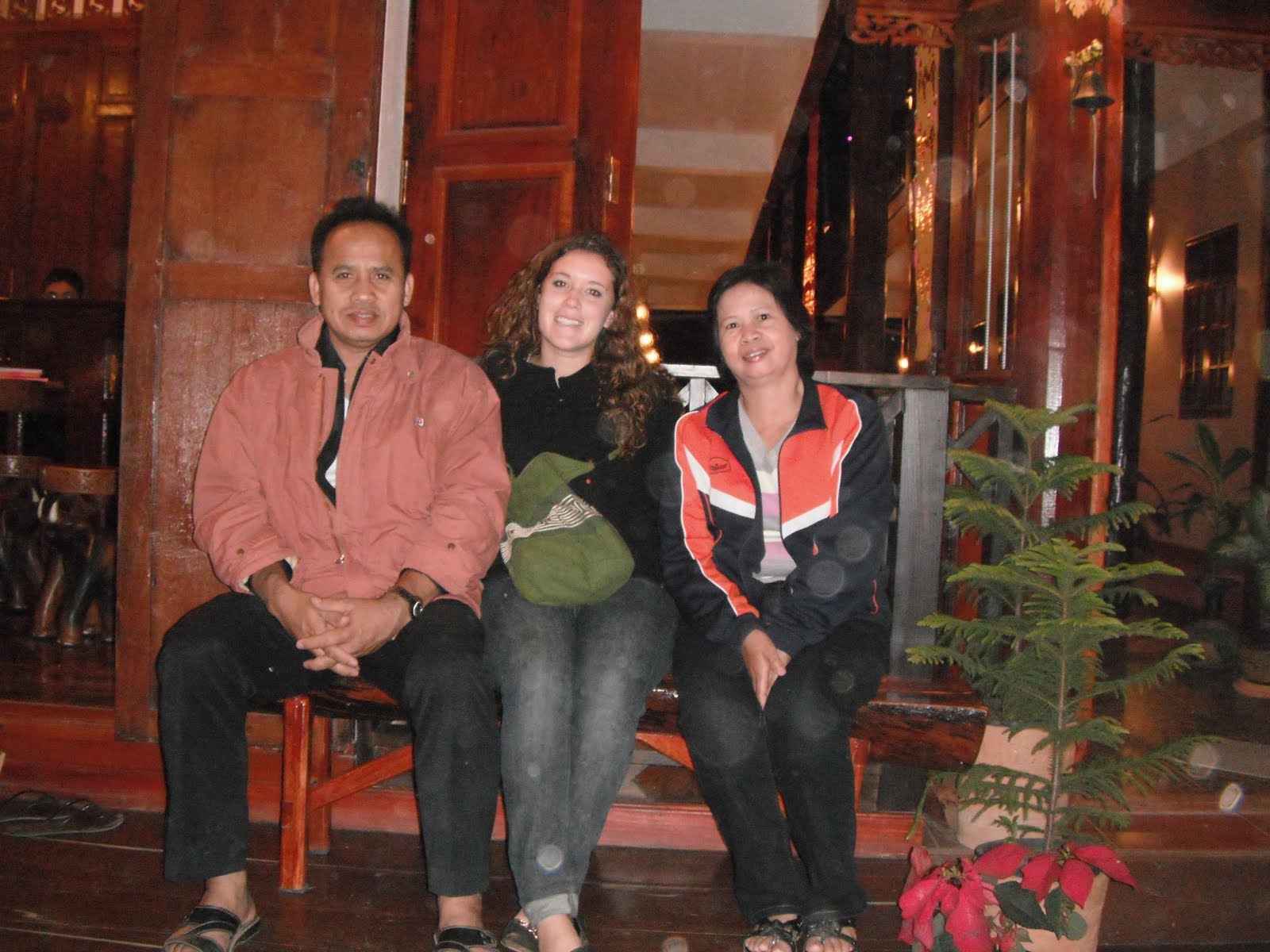
<-----Bai Tuey!

Wednesday, July 13, 2011

Somebody call the doctor

The past few days I've come down with a high fever, sore throat, headache, and all over miserableness. Being sick at home in the US is already bad enough, but put that in a foreign country where nobody speaks your language it's about 10x worse. I knew before coming to Thailand that I would inevidently probably get really sick at least one time but I didn't think about the cultural differences that there would be about how to treat or act to someone who is sick. When somebody is sick in the US you usually let them rest by themselves and leave them to get better, maybe offering to bring by some soup. In Thailand, just about everybody will be knocking at your door or in my case yelling up to my window until you answer. They come into your house (of course always with the best intentions) to give you medicine and fruits and want to chit-chat getting a detailed account of all your symptoms (keep in mind this happens multiple times). You can imagine the pantomiming that goes on here is pretty hilarious too. For me, when I'm really feeling sick I want to be by myself, lay in bed and hopefully sleep. The concept of "alone time" is unheard of and not widely accepted mainly because of the fear of ghosts. For example, I have three student teachers living next door to me now, who are also 23 years old, and instead of each sleeping in their separate rooms they all sleep next to each other in one room! Yes, personal space is minimal to non-existent, which is why worldteach made sure each volunteer had their own room.
Anyways, back to my sickness. Yesterday when I was really feeling in the gutter and had run out of medicine for a fever I decided to go to the hospital to get my temperature read and stock up on more medicine. The hospital in my village acts more like a doctors office containing only a few doctors and is a little rustic to say the least. I went with one of my teachers to help translate the little english that she knows. The trip was like what I'd heard from other volunteers that have been to a hospital in our teaching areas but I guess I needed to experience it for myself. I wasn't feeling too hot, or I had a fever, so I was feeling really hot and not in mood for the farange stare-down from everybody in the hospital. My teacher and I were constantly bombarded by people wanting to know what I was doing there and exactly what was wrong. Since I and all the other worldteach volunteers had checked into the hospital when we first got to thailand to get a health clearance for our visas, my name was already in their system. However, I and another volunteer have basically the same first and last name making is virtually impossible for Thai people to tell the difference. Heather Jones and Heather Johns...really! That caused a lot of confusion at the hospital and time of me explaining that it is 2 people after they tried to give me a slip for Heather Johns who somehow also was misrecorded to by 33 years old?. So I wait an hour and finally get to see the doctor who is a young lady in her late 20's I'd guess. I'm pretty sure I was the first foreigner she'd seen because she had no idea what to say or do. She barely even looked at me and there were long awkward silences. She asked Pi Med some questions and wrote out about 5 prescriptions for various aliments. oookkkay I guess that's it. I pick up my prescriptions which cost about $4 for 5 difference medications and we are on our way. On the way back to my house Pi Med turns to me and laughs saying that the doctor was veryy veryy shy. Lets just hope this is the last of me being sick in Thailand!

Saturday, January 8, 2011

Day in the Life of a Thai Student


Update, finally! I haven't had internet at my house for the past 2 weeks or so now and I haven't been very willing to sit outside in the cold at the high school to pick up their wireless for very long!


This is an account of what a day in the life of
one of my Thai students might look like. However, everyday I am amazed at the different cultures and routines each of my elementary schools has so this account is one specific to my smaller more rural elementary school PlaPak Noi. This school has already become very dear to me and acts more like an extended family for the students and teachers. The teachers are more like parents in charge of disciplining and teaching students life skills.


Every morning starts with a morning assembly. The time mainly depends on when the teachers arrive at school this can be 8:15-9am. Students line up in their grade levels in perfectly straight lines equally spaced apart. The flag is raised, national athem sang, buddhist prayer said, and a marched exit accompanied by drums.

School Maintaience responsibilities fall mainly upon the students. They are incharge of sweeping, mopping, picking up any trash, watering all the plants, and picking up leaves (by hand), and even helping with construction. Right now my students have been helping with the construction of a new building of classrooms(funded by donations) to replace the open-air wooden room that houses sometimes up to 3 grade levels. I will see my tiny 2nd grade boys hauling huge cinder blocks or digging out the side of the hill to insert steps. I find this involvement in the school and its upkeep very beneficial to the students who then respect and appreciate their school. I do sometimes worry about their safety with the construction though.


In the next block of morning classes grade levels will rotate through my english class. I found that the morning schedule really revolves around my class since the bell is manually rung only by my students exiting the class. I dont think the bell is used at all when I'm not at the school. Time at the school runs on daily events rather than a schedule. When the students aren't in english class they are maybe working from workbooks, cleaning something, or the older students helping prepare lunch. Everyday it seems like my students receive a small cooking lesson (which sometimes I wish I could join!).


Lunch is then served with the menu usually being sticky rice, steamed veggies, fish soup, somtam salad, fried egg, and pork. However frog and chicken feet occasionally pop up too! After the teachers are done eating my 5th and 6th grade students are in charge of washing all the teachers dishes and cooking bowls.In the picture you can see the wash tubs that are usually surrounded by dogs looking for leftover scraps. The afternoon I teach Kindergarden-2nd grade and the older students play sports, scrub floors, or work on their prized vegtable garden they started a few weeks ago. Here is a video of my students one afternoon working in the garden.


Drying rack of students family style lunch plates


The end of the school runs similarly to the morning assembly but without the drums and flag. Students line up say a prayer, thank the teacher, and are then excused to go home. The time for this also varies greatly on the teachers after school plans.

I find myself usually conflicted with the my student's school routine. On one side I think it is great that the students are involved in the upkeep of the school, how respectful they are to the teachers, and the flexibilty in the school schedule. If something important comes up or could be benefical to the students the schedule should be able to change unlike the strict American school system dictating teachers every lesson plan. However there is a severe downside to the Thai way. I feel like the teachers sometime take too much advantage of their "power". One afternoon my students were washing a teachers car or how they scrub the floors every week instead of being taught. My students are learning valuable skills such as growing vegetables but as far as more academic learning seems to be missing or involved classroom teaching. This is part of the culture of Thai Teaching that we as volunteers are hopefully modeling for the rest of school on how to make classroom learning fun, meaningful and relevant to the student's lives. Recently I was notified that the school board was coming to observe me teach at PlaPak Noi and videotape my english lessons to use as example for other thai teachers. Even though I hate to be videotaped or observed teaching for that matter, I'm happy that the school board is taking note to how we teach without a the use of a workbook and are willing to incorporate new teaching strategies.

Tuesday, January 4, 2011

Happy Birthday to the New Year


Sawadii Bii Mai (happy new year)!
The last week has been pretty crazy celebrating New Years and taking a trip to the city of Chang Khan with my Thai Family for their annual family reunion. On Thursday at Wang Yang we had a school wide gift exchange. Every student and teacher (88 total) brought a small gift which I later found out means bring a 30-40 baht= $1 kanom (candy)- single bottles of soda showed up also to exhange. After all the gifts were numbered each person had their turn to pick a number and receive the corresponding gift. This took about 3 hours...all to exchange little candies.

After school I had about an hour to gather my backpack before Pi Med came to pick me up to begin a 7 hour journey to Chang Khan. However in typical thai fashion we didn't leave the city (nakhon phanom) till around 7 pm meaning we didn't arrive at Pi Med's sisters house in Chang Khan till 2:30 am! The ride was long and the car was FREEZING. For some reason Thai people like their cars really really cold. Everybody was bundled up in jackets and the whole time I was just wondering why don't they turn down the AC. After shivering for a few hours I politely asked to turn down the AC or turn on the heater. This was pretty stupid since I was quickly informed Thai cars don't have heaters! Once we arrived at the house Pi Med's daughters, Sohm 25 yrs and Ying 21 yrs , and I all jumped into one bed for the night. Waking up only a few hours later to the sound of roosters I began my introductions to the extended family. We had a traditional Thai breakfast which usually consists of sticky rice, fish soup, Laab (meat salad), and Somdtam (papaya salad). The whole trip I didn't sit at a table once. Everything is eaten on the ground with bamboo matts. Also there was no stove or oven. All the food prepared at the house was done over a fire!


In the Pictures below I got to learn how to make a traditional rice noodles. In the pot is the sticky rice mixture with the finished noodles in the tray next to it. To make them you squeeze the noddle mixture into a hot pot of water then use a net to scoop them out.


Their house was situated on the Mekong River, boarding Laos. In the mornings I would walk in the Mekong River, since the water is really low right now, and watch the fog uncover the Lao Mountains. Beautiful!


On one of the mornings I saw an old lady turning over rocks looking for frogs in the river to become her lunch. I decided that this looked fun and joined in the frog hunting (reminds me of golf ball hunts :) ). Eating frogs here is a delicacy.
This is her carrying her bag of frogs.


I also got to be a part of trying to cook the meals. Here is a roasting pot of Buffalo Skin. This is the cricket that I ate...not too bad actually.


The "downtown" had a very old-fashioned feel to it with most of the buildings made of wood and is where a festival was held on New Years Eve. We spent the night walking the streets, watching the fireworks, and doing a countdown. New Years is a very family event and there was no alcohol or partying for me this NYE.


Of course spending a whole trip with only Thai People we had a share of miscommunicates. Here are some of the clarifications we had to make:
*Los Angelos is NOT a state, but a city in California.
*If someone is trying to give you something and you say , "It's Okay". That means NO not yes.
*Thai Cars don't have heaters.
* "I make picture for you" means Let me see your camera and I will take a picture for you.
*Sitting cross-leg on bamboo mats for hours takes practice

Overall it was a very very Thai New Years and a great experince of the family culture. I loved seeing the interactions between family members and especially the older grandmother and fathers. They are treated with such respect and kindness. I hope everyone had a wonderful New Years and I wish you the best in 2011!!
My Thai Family: Mother-Pi Med Father- Pornchia Daughter: Sohm and Ying


Side Note

**At my school yesterday I made gucamole for my teachers after spotting Avocado at Tesco. My teachers had never tried avocado and my students kept calling it an olive so I thought it might be a good cultural food to share. In summary they thought gucamole was discusting and said I needed to add lots of fish sauce, sugar, and chunks of chili peppers to it! Since I couldn't find any tortilla chips I opted for my next best option, sticky rice!

Sunday, October 10, 2010

Adjusting to Thai Customs


After one week down in Thailand, we've come across many customs and "ways of life" that are very foreign and rather odd to the western frame of mind. Below is a list of a few of our adjustments that we are still trying to master:

1. Squatter toilets: Basically the nice version of a hole in the ground consisting of spots to place your feet and squat down into a bowl. This is followed by manually flushing with a bucket of water.

2. Shower: Going off the toilet situation, there is no separate area for the shower. Literally I've been showering next to a urinal. This also makes for a very wet bathroom. There is also no hot water which I'm slowly adjusting to when I take my 6:45am shower. Also note that some volunteers this year wont have any sort of shower head and will be using the traditionally bucket and water method.

3. Clothing: Being located in the Isan district of Thailand, they follow a more traditional conservative dress code. Women should typically always have their shoulders to knees covered (even walking to and from a shower). Even though we are in the "cool" season in Thailand this can be very warm! As far as teaching goes, dress should always be "rip roy" which is the Thai name for neat and tidy. Many women wear heels to work, even through the mud of the school campus, and neatly pressed suit to work. Always presenting oneself in a professional manner is important to Thai here even though there is so much poverty.

4. Wai: The Wai is how Thais greet each other and is an indicator of respect. Where you put your hands in the Wai indicates the amount of respect you are showing (palms together at chest= same level in heirarchy, palms between mouth and nose=higher and Forehead= for monks or king) Teachers never Wai students because there are "higher" level. You may receive a students Wai though by placing palms together at chest level.

5. The body: Different parts of the body have very distinct values the top of the head being the most important. This means you should NEVER touch someone on the head, it would be extremely rude and disrespectful. Opposing is the feet. Pointing the bottom of your feet at someone is also considered very rude. For many of us the way we sit has had to change making sure when we sit with our legs crossed or on the ground we aren't offending someone. Because feet are so dirty, even setting over someone else or for example a purse would be rude This value goes all the way to how you hang your clothes. On a clothes line you always hang your shirts higher than pants being in the middle and undergarments at the bottom.

6. The King: Being the most valued and important person in Thailand you will see the Kings picture EVERYWHERE. Golden arches are a common site across roads with the Kings picture. On tuesdays, everyone wears pink (even men) in honor of the King and wish him good health. If you were to be caught talking down on the King you would be imprisoned.

7. Men & Women: Thailand is extremely hierarchical. Hanging your clothes higher on a drying rack than the elder male in the household would be disrespectful. Men are also allowed to have several Wives. Many of the women know this but are forced to turn a blind eye. As far as showing affection women and men who aren't a couple should seldom to never touch. Placing a hand on a mens arm might send very mixed messages and others would probably think they are dating. On the other side women are very affectionate with each other holding hands and linking arms when walking. I experienced this when I met on of my co-teachers and send immediately started holding my hand as we walked to our welcoming party.

8. A few others: Taking shoes off when entering a room, eating food by using your fork to push food onto a spoon, stray dogs everywhere, cows in the roads, cell phone interruptions being okay even in the middle of class or at the dinner table, sitting in the back of pickup for taxis, little children (as young as 1 or 2) sitting front seat driving dirt bikes with parents behind, no toilet paper, blowing your nose being rude but picking it okay, ....

There are many more customs that I'm learning about and experiencing as I stumble my way through the culture trying my best not to offend or disrespect others. Once I'm out of my "english bubble" of orientation training I know the cultural adjustments will turn into more day to day living. So far I'm amazed at the country and the village of Pla Pak where I'll be living. The people in general seem to be amazed at the sight of a farang (white foreigner). Many blatantly stare at you walk down the street or whip out their cameras for a picture. My Thai is very very slowly improving and I'm starting to notice a few words when people talk and continually working on the Thai alphabet.

Today we went to the city to culturally observe and do some shopping. The picture above is some volunteers and myself visiting a wat (temple) and practicing the correct way to enter, wai, and exit when in the presence of buddha. I managed to upload a few pictures under photos but still trying to figure out a more efficient way.

Ovens, Microwaves, large stoves, freezers are rarely seen in Thailand. Here is a sneak peak of my kitchen...